Free shipping, every order · 30-day guarantee · From Orange, California
The Makeup Table Cup Holder.com ← back to the makeup table page

The makeup table file

Why drinks tip at the makeup vanity — and what it actually takes to keep one steady through a GRWM

A vanity doesn't fail a drink through one clumsy elbow — it fails through a table too shallow for what's already sitting on it, a working posture aimed at the mirror instead of the tabletop, and cords and carts that move things without anyone touching them. This is the physics behind why a cup goes over at a glass-top dressing table, a DIY desk-vanity, or the bathroom counter mid-routine, what the beauty community already tries instead, and what a base actually has to do to survive a session.

A table that runs out of room before the routine does

A category-defining dressing table like IKEA's MALM measures about 47 1/4 inches wide, 30 3/4 inches tall, and only 16 1/8 inches deep, with a tempered-glass top sitting directly over a felt-lined drawer — there's no lip along that edge, because the drawer front is the edge. The DIY alternative the beauty community actually builds runs the same way: a laminated top over stacked IKEA ALEX drawer units, each about 14 1/8 by 22 7/8 by 27 1/2 inches, with the drawer fronts flush to the underside of the top. IKEA's own product reviews for the ALEX line include people describing adding a custom top just to turn it into a vanity — a built, not bought, category of furniture, and nobody built in a spot for the drink.

Sixteen inches of depth sounds like enough until a mirror base and an open palette are sitting on it. Subtract both and what's left is a strip a few inches wide, inside the reach of an elbow leaning toward the glass. Every other object on the table was chosen for the routine; the drink is the one thing that has to fit into whatever's left over.

A posture that works with eyes on the mirror, not the table

Doing a full beat means working close: leaning toward the glass, watching the reflection instead of the hands, and letting the forearm rest on or sweep across the tabletop between brush changes. That arm isn't aimed at anything on the table — it's braced against it, or moving toward a palette or a brush cup — which makes contact with whatever else is sitting there a byproduct of the routine rather than a mistake in it. A full face of makeup involves dozens of small reaches like this: a new brush, a corrective wipe, a switch from one pan to the next, each made without a glance down.

Filmed sessions add a second version of the same problem. A GRWM setup points a ring light and a phone at the person, not the table, so the performer's attention target and the table's actual contents are two different things — a gesture that reads as speaking to the lens also crosses whatever's standing in the strip between the tripod feet and the phone. A curling iron or dryer cord dragged from one side of the head to the other doesn't make point contact the way an elbow does; it drags sideways along the whole surface, catching anything sitting anywhere in its path, not only what's directly under the hand holding it.

The trade is lopsided: a cheap drink next to expensive everything else

A lighted Hollywood-style mirror is furniture in its own right, not an accessory — a mid-size model weighs around 39 pounds, with its own accessory outlets and USB ports built into the side facing the table, live hardware sitting inches from wherever a drink ends up. The math runs the same way underneath a glass-top dressing table: the felt-lined drawer sits directly beneath the tempered-glass top, holding whatever palettes didn't make it onto the visible surface — all of it one thin pane away from anything that goes over on top of it.

The bathroom counter compounds the problem instead of relieving it. Threads about small or shared bathrooms circle the same shortage, nowhere flat near the sink for anything, and that's exactly what pushes people to overflow onto a rolling cart. But a cart's shelves are deep trays with a raised lip, built to keep loose product from sliding rather than to hold anything level, so the surface meant to solve the space problem was never flat enough to hold a drink either.

Wondering about your specific cup? The fit database has sourced base measurements for 30+ containers — Stanley, Red Bull, Yeti, and the honest no's.

The fixes already living on this table, and why none of them hold

A clamp-on desk cup holder needs a bare, overhanging lip within a narrow thickness window to close around — one widely sold model only opens for tops between about 0.5 and 2.5 inches thick — and neither vanity style offers that lip at any thickness. A MALM-style drawer front is flush with the top it sits under, and a stacked ALEX build has drawer faces running the same line as the tabletop above it, so there's no ledge on either one for a jaw to close on.

A tray or a coaster changes what's directly under the drink without changing what's around it: a mirrored or lacquered surface adds a second slick layer rather than a grippier one, and neither does anything when a forearm catches the cup mid-motion instead of setting it down hard. A rolling cart solves the wrong kind of movement, too — once its casters are unlocked, there's almost nothing holding the cart against the floor, so a bump that would only nudge a stationary drink instead sets the whole cart moving. And a clip-on holder built for a chair arm or a car door closes around a can-sized object; the dome-lidded iced coffee cups and wide tumblers this table actually holds were never going to fit the slot.

What it actually takes to hold steady here

None of that is one obstacle so much as several, stacked on the same few inches: a shallow table, a crowded top, live power close by, and a routine that keeps its eyes on the mirror instead of the hands. A working answer has to grip without an edge to clamp to, hold without a dry surface to seal against, and take contact that arrives as a drag across the whole surface as often as a direct hit to one spot.

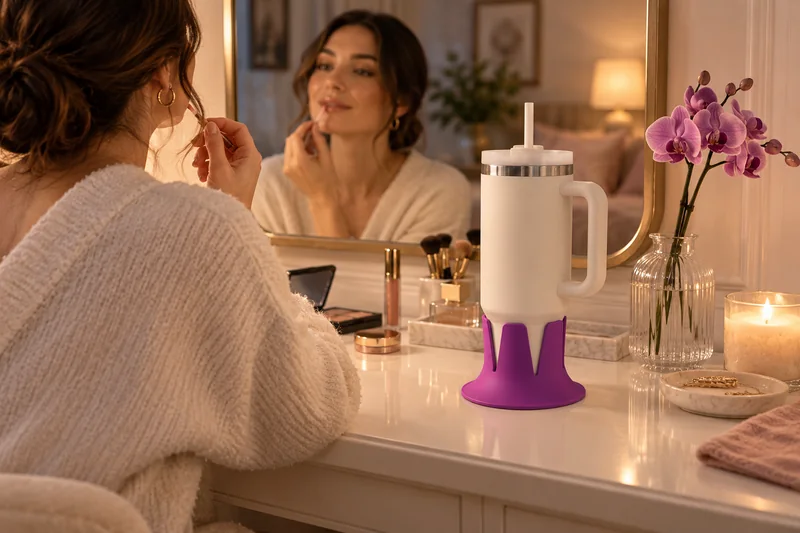
That's the job a wide, flexible base spread across more of the surface is doing: more contact area means a bump has to move more of the base before the drink itself tips, the same reason a wide-set object is harder to knock over than a narrow one. Fins that flex in around the container's lower inch keep that grip anchored to the cup itself rather than to whatever happens to be underneath it — a lipped cart tray included. A knock from a blind reach or a passing cord flexes the base rather than tearing loose from it, and it settles in level again once the motion passes.

None of that stops a bumped brush or undoes a ruined palette on contact — but a base that resists tipping through the lean, the cord, and the reach toward the camera keeps the drink out of the vanity's real risk zone, which is most of the problem this table actually has.

Get one — ships free

Checkout happens at steadilabs.com — that's the maker's own store.